How Does Art Change in the Whale Rider Film
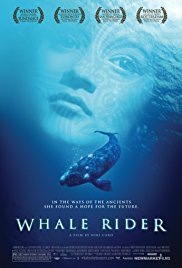
WHALE RIDER
SUBJECTS — New Zealand; ELA, including label, symbol, and foil;
SOCIAL-EMOTIONAL LEARNING — Breaking Out; Female person Role Model;
MORAL-ETHICAL Accent — Respect.
Age : 12+; MPAA Rating: PG-13 for brief language and a momentary drug reference;
Drama; 101 minutes; Color. Bachelor from Amazon.com .

MENU
MOVIE WORKSHEETS & STUDENT HANDOUTS
Clarification
Paikea Apirana's grandfather is the Chief of a small Maori tribe in modern-day New Zealand. Maori tradition provides that merely first born sons tin be chief. All the same, Pai's father, the next in line, has declined to have the function. If Pai had a brother, he would go chief, only her just brother, her twin, died at birth, along with their mother. Although Pai's grandfather, Koro, loves his granddaughter, he is determined to find a male to serve as his successor.
When "Pai" is 12, Koro establishes a school to teach adolescent boys the aboriginal customs and to develop the skills to enable one of them to get the tribal leader. Pai learns the lessons on her own and knows that she is capable of beingness the Chief. Although Pai works hard to earn Koro'due south respect, she is rebuffed each time she tries to main an activeness traditionally reserved for males. And so a pod of whales, an brute revered by the Maori, beaches itself on the sand well-nigh the tribe's home. It is Pai who saves the whales and, in so doing convinces, her grandfather that she should exist Chief.
The story describes the efforts of an indigenous grouping living within modernistic Western society to continue their traditions while assimilating some aspects of the dominant culture.
SELECTED AWARDS & CAST
Selected Awards:
The flick won many awards at film festivals. It besides won the 2003 BAFTA Children's Award. Keisha Castle-Hughes was nominated for the 2004 Academy Award for Best Actress in a Leading Role.
Featured Actors:
Keisha Castle-Hughes as Paikea; Rawiri Paratene as Koro; Vicky Haughton as Nanny Flowers; Cliff Curtis equally Porourangi; Grant Roa as Uncle Rawiri; and Mana Taumaunu equally Hemi
Director:
Niki Caro.
BENEFITS OF THE MOVIE
"Whale Rider" offers young people the opportunity to learn about a different civilisation and to examine the difficulties that many traditional groups experience in facing modify. Students can examine their own concepts of gender roles as they watch entrenched sexism diminish through the course of the film. The importance of myth and stories which shape the lives of traditional people will become clear to viewers and will offer the perspective necessary to await at their ain myths and stories.
ForEnglish language Language Arts Classes, the movie offers an opportunity to explore theme and the literary devices of characterization, metaphor, symbol, and foil. "Whale Rider" also provides an occasion for research, oral presentations, and essay writing required skills in near ELA curricula.
POSSIBLE PROBLEMS
PARENTING POINTS
Enjoy this movie with your children. The message is clear and requires no discussion. Nonetheless, if you can chronicle the situation of Paikea or the grandfather to a struggle being waged by someone your child knows, information technology would be worthwhile to highlight the connectedness with a comment.
USING THE Pic IN THE CLASSROOM
USING "WHALE RIDER" IN THE ELA CLASSROOM
The brief introduction suggested below volition orient students to the film and provide background about Maori culture. The introduction will also lead to "aha!" moments as students recognize aspects of Maori civilisation described in the lecture while watching the moving picture. This volition increment their appreciation for the movie. Suit the presentation to the needs of detail classes. After students have seen the motion-picture show, engage the grade in a word about the themes of the story. Discussion questions and suggested responses are provided beneath. Students tin then be asked to take a deeper wait and research questions that have been discussed in class. The results of their research tin can be presented to the class in oral reports or serve equally the basis for a writing assignment. See Assignments, Projects & Activities.
Earlier starting the introduction, on a earth or map of the globe, bear witness students the locations of New Zealand and Germany in relation to each other and to the community in which they live. The comment that Germany is but nearly as far from New Zealand as a person can get.
INTRODUCTION TO THE Moving picture
The Maori at present number about 650,000 people, 15% of the population of New Zealand. They migrated approximately chiliad years ago from Hawaiiki, an unknown Polynesian island east of New Zealand. Information technology is possible that Hawaiiki was 1 of the Hawaiian islands. The Maori were the first human being beings to live in New Zealand and brought with them a highly evolved Stone Age culture. Past the time the Europeans arrived in the late 1700s, the Maori were well-established. Like most other indigenous cultures, Maori tribes were no match for the diseases and gun-based military machine prowess of the Europeans. In 1840, British rule over the Maori was formalized in the Treaty of Waitangi, which granted British citizenship and land rights to the ethnic people of New Zealand, although most of the state was confiscated for European settlers.
According to myth, Paikea was the founder of the Maori people. His father was a Chief in Hawaiiki with many wives and numerous children. Rua-Tapu was the son of the Chief and a slave woman, while Paikea and the Main'due south other sons were born to women from aristocratic families. When Rua-Tapu tried to employ a sacred comb belonging to i of his high-built-in brothers, he was humiliated by the Chief who made information technology clear that Rua-Tapu was of a lower caste than his siblings. In revenge, Rua-Tapu decided to kill all of his half-brothers, including Paikea. He invited them, 70 in some versions and 140 in others, for a trip in a cute bounding main-going canoe that he had built. Nevertheless, this canoe was designed to have a hole that Rua-Tapu kept sealed with the heel of his foot. When the canoe was far out to ocean, he moved his foot and all aboard drowned except for Rua-Tapu and Paikea, the latter being saved by a whale who took him to New Zealand. Paikea became the ruler of the people who lived on the islands.
Maori consciousness is shaped past reverence for ancestors and the past. Earlier Europeans arrived, the Maori linguistic communication was not written. Individual genealogy was remembered through the he rakau wakapapa-paranga, a board with a notch for each name and a bare space to denote when a male person line of descent died out. Maori children were taught nearly their ancestors by memorizing the names of the person represented past each notch. In modernistic times, the interior rooms of Maori meeting houses are places sacred to the ancestors. Traditional myths and data about navigation are carved into the walls.
Maori culture was male-dominated, with women generally serving in subordinate roles. One traditional function of Maori women was the "karanga," an substitution of calls that forms part of the Maori welcoming ceremony. As a visiting group moves into the formal meeting surface area, they are welcomed by a call from a woman of the household or village. The visitors respond and the calls go back and forth every bit the newcomers enter the location where the meeting is to occur.
Click here for a still motion-picture show of two women calling a karanga. This link volition take y'all to a video of the scene from the movie in which a karanga is called and answered as students are welcomed to the opening of their new schoolhouse. The karanga occurs in the starting time sixty seconds of the segment.
The Maori were violent warriors and would, at times, dine on their conquered enemies. Many Maori carvings show fierce faces with stuck out tongues.
See Case #one and Example #2 . This will presage a scene in the film.
Maori tattoos are famous for their intricate designs, size, and beauty. Called "Ta moko,", they consist of of import symbols that help individuals limited their unique identities. In the 1700s, when Europeans first arrived in New Zealand, it was common for Maori to have tattoos covering their entire face. This custom died out by the cease of the 1800s, although Maori continued tattooing other parts of their bodies. The Ta moko was predominately for males and amongst traditional Maori it was rare that a woman would accept tattoos. In contempo years, tattooing has become common for both men and women.
See Drawing of Maori Confront Tattoo and Modern Day Face Tattoos .
The traditional Maori greeting is to press noses. This is called "hongi," a gesture that is the social equivalent of a handshake or a kiss on both cheeks.
See Hongi Example #i for an image of the traditional Maori greeting. This will presage several scenes in the movie.
Cross-Curricular Annotation:
Gondwana, also called Gondwanaland, was an ancient supercontinent that incorporated present-day New Zealand, Australia, Antarctica, South America, Africa, Arabia, Republic of madagascar, and India. It was assembled from parts of previous supercontinents by the Late Precambrian time, some 600 million years agone. It started to interruption up about 180 1000000 years ago in the Early Jurassic Menses.
New Zealand separated from the Antarctic portion of Gondwana nigh 82 million years ago, condign geographically isolated. The plants and animals in New Zealand have evolved into forms that are slightly unlike from those on the other state masses. Before the Maori found New Zealand and colonized it a piddling more than a thou years ago, the only mammals that inhabited New Zealand were two species of bats. At that fourth dimension, the fauna of New Zealand was dominated by insects and birds. In the absence of swift and agile mammalian predators, some species of birds had lost the ability to fly. The Maori found them to be easy casualty and speedily killed them off. Nigh are now extinct.
DISCUSSION QUESTIONS
1. See Questions Suitable for Any Film That is a Piece of work of Fiction .
two. How would you lot describe Paikea?
Suggested Response:
Pai is intelligent, patient, and fun. She respects and loves both her grandpa and Maori tribal traditions. She never lets her acrimony get the best of her. When Koro is cruel and refuses to respect her as a human being to be evaluated based on her character and abilities, she forgives him for his intransigence. However, Pai is strong. She persists and fights for what she wants.
three. How practice the women in the picture deal with the sexism of their tribe?
Suggested Response:
The women permit the men think that the men are the bosses. The women bear on with their lives accepting the men, notwithstanding criticizing the men's thinking. This tin exist seen when the women play cards and joke about the men. Pai's grandmother can exist highly disquisitional of Koro, yet she tolerates him using humor. She sympathizes with the difficulty of her husband's life, telling her granddaughter, "He's got a lot of rules to live by."
4. There are several symbolic meanings in the scene that starts with Koro unsuccessfully trying to employ a rope to kickoff an engine. The rope breaks and Koro leaves to discover another. Pai ties the rope together and and then easily starts the engine. When Koro returns he admonishes his granddaughter, telling her that what she has done is dangerous and that she should never exercise it over again. Some of the symbolic meanings in the scene are stated by Koro while others tin be recognized by the viewer. Describe the symbols shown by this scene.
Suggested Response:
The symbolic meaning stated by Koro is that each strand of the rope represents an ancestor with the rope being the tribe. He notes that when all of the threads are woven together they make a strong rope. Then the rope breaks as Koro tries to start the engine. This symbolizes his inability to lead the tribe. Another symbolic action in the scene occurs when Pai ties the rope and uses it to brand the engine start. This is a symbol for her ability to pb the tribe in a way that Koro cannot. Koro's reaction to what Pai had washed is nonetheless another symbol. He tells her that what she did was unsafe. This shows that he thinks Pai'due south leadership would be dangerous to the tribe, despite the fact that she can exercise what he cannot. This symbol can also be seen every bit representing his inability to see the strengths of Pai's character and to foresee the best path for the tribe to take in the future.
five. Why does Porourangi, Koro's first born son and Pai'southward male parent, leave habitation and live in faraway Germany?
Suggested Response:
There are several possible reasons. Germany is very far away from the life of the tribe, in terms of both altitude and culture. Pai'south male parent tin be his own person in Germany, away from the restraints of his father, the tribe, and Maori culture. Like many ethnic people, Porourangi is torn betwixt two civilizations. His response to the strong ties that he feels to Maori culture and the pressure to be master is to make a clean break. He needs to become far away to fully develop as an individual and as an artist. If Porourangi had tried to stay in New Zealand, he would have had to constantly confront Koro'due south disapproval. For example, Koro calls Porourangi's fine art "souvenirs." The one-time man blames Porourangi for not producing a son and heir to the chieftainship. Porourangi later tells his daughter that the one-time man is looking for something that no longer exists. When he tells Pai that he cannot be what Koro wants, Pai says, "Me neither." Ii other reasons are worth mentioning. Pai's father needed to distance himself from the place where he lived with his wife and where he lost both his wife and his son. Living in the village or even in New Zealand would have reminded him of this loss. In improver, the screenwriter needed to make Porourangi's rejection of the role of chief to be emphatic and permanent in lodge to make Pai's rise to the position believable. Thus, sending Porourangi to Deutschland advances the plot.
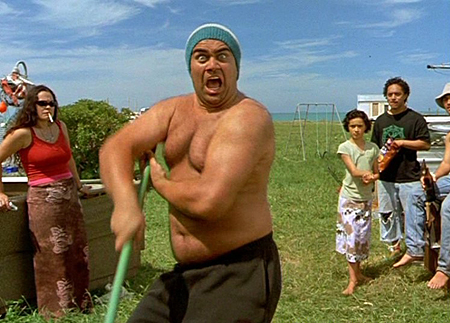
six. Pai learns how to utilize the state of war sticks, the Taiaha, from Uncle Rawiri. Using this knowledge, she defeats Hemi, a boy trained by Koro himself. What is revealed about Pai and her uncle in this episode?
Suggested Response:
Pai's defeat of Hemi is a symbol that she is the leader for whom Koro is searching. Viewers also larn that Uncle Rawiri was once a champion with this traditional Maori way of fighting, although now he appears to be lazy, fat, and a user of drugs and alcohol. His mother says that this stems from the fact that he is a second born son and therefor, according to Maori tradition, he can never become primary.
7. Hemi'due south father comes to run across his son for a cursory part of the ceremony at the school and and so leaves with his friends. What does this suggest about the tribe'south problems?
Suggested Response:
The tribe and the Maori families are breaking apart because the men are leaving. Paikea's begetter, Porourangi, is the most important example of this. Hemi'southward male parent is another.
8. Pai makes an important point that clearly establishes theme in the speech she delivers in accolade of her grandfather:
I bankrupt the line back to the ancient ones. It wasn't anybody's fault, information technology just happened. But nosotros can learn. And if knowledge is given to everyone, we can have lots of leaders. And soon everyone volition be stiff, not only the ones that have been called. Because sometimes, even if you're the leader and yous need to be strong, you can become tired like our ancestor Paikea when he was lost at sea and he couldn't find the land and he probably wanted to die. But he knew the ancient ones were there for him so he called out to them to lift him up and give him strength.
What idea in this spoken communication offers the solution to the trouble faced by both Koro and the Maori as a whole?
Suggested Response:
Pai argues on behalf of egalitarian leadership, asserting that anyone with knowledge can exist of value to the tribe and that strength can be found in having several types of leaders rather than ane. She conspicuously asserts that tradition can hinder progress.
9. A rope is seen in the episode in which the villagers endeavour to assistance the beached whales render to the bounding main. This is an echo of the earlier symbol of the rope. What idea is conveyed by this scene?
Suggested Response:
The villagers desperately try to help the whales, pulling together as implied by the tribal custom, becoming the living image of the strands that brand up the rope of a united hamlet. Despite their joint efforts, the rope breaks and they walk away exhausted. Withal, when Paikea climbs atop the whale it responds to her and leads the other whales back to the sea. The symbol is that even with anybody in the tribe pulling together, the purpose cannot be achieved without the proper leader. At this point, even Koro understands that a leader may emerge, non from tradition, but in the form of a young girl who has the grapheme, skill and want to exist chief.
x. Uncle Rawiri is an interesting character and in many means a foil for Paikea. Depict the attributes of this graphic symbol, how they relate to the themes of the film, and how Uncle Rawiri is a foil for his niece.
Suggested Response:
Paikea'due south uncle, skilled in the art of fighting with war sticks, is not considered fit for the role of Chief because he is the second son. However, he is a nurturing man and a leader in the community just past forcefulness of his winning personality. This is conspicuously shown in the scene in which he rallies the tribe to try to salvage the whales. There is no reason he should not be chief. In this, he is similar Paikea who cannot be a chief only considering of her birth: she is a adult female. Her leadership qualities, noesis of Maori civilisation, and skill with the Taiaha cannot gain for her what they would had she been a firstborn son. Withal, different Paikea, Uncle Rawiri accepts his fate, becoming overweight and escaping into alcohol and drugs. This highlights Paikea's decision to struggle confronting the fate that would have been hers had she not get Chief.
eleven. In this story, the Taiaha, the ability to fight with state of war sticks is a symbol. What does information technology symbolize?
Suggested Response:
At that place are several possible ways to express this. They include: leadership, unity with the Maori culture, and noesis of that culture.
12. What important aspects of grapheme are shown at the film's cease?
Suggested Response:
Koro acknowledges that Paikea volition succeed him as Master of the tribe. He has opened his heed and abandoned his rigid adherence to the erstwhile rules. Pai forgives him, of class, and says later that she is no prophet and that she knows the Maori people "volition keep going frontward all together with all of our force." Here she shows the value of humility.
SOCIAL-EMOTIONAL LEARNING
BREAKING OUT and Female Part MODEL
See Discussion questions numbered ii, eight and 10.
MORAL-ETHICAL Emphasis (Grapheme COUNTS)
Discussion Questions Relating to Ethical Issues will facilitate the utilize of this film to teach ethical principles and disquisitional viewing. Additional questions are set out below.
RESPECT
(Care for others with respect; follow the Gold Rule; Be tolerant of differences; Utilize good manners, nifty language; Be considerate of the feelings of others; Don't threaten, hitting or hurt anyone; Deal peacefully with anger, insults, and disagreements)
1. In that location are many harms caused past any prejudice, including racism and sexism. Encounter if you can list at least four. Look at the problem from the standpoint of the victim, the perpetrator, and society as a whole.
Suggested Response:
The many harms caused to victims of prejudice can be placed into two classes. Prejudice limits the ability of the victims to the live the lives they want and to live and to relish their inalienable correct to "life, liberty and the pursuit of happiness." In improver, in societies in which prejudice dominates, the victims tin internalize the prejudice against them and come to believe that they and their group are, in fact, inferior. This is especially harmful to children who grow up as second-class citizens in a society that condones prejudice. For the perpetrator, prejudice makes it incommunicable to have meaningful relationships with an entire course of people and deprives him or her of the satisfaction of participating in a society that is fair and but. For society as a whole, prejudice limits the contribution that the victims tin can make. Prejudiced societies also lack a key sense of justice and fairness. This tin poison intergroup and personal relations.
two. Which of the evils of prejudice are shown operating in this movie?
Suggested Response:
All of the problems with prejudice are shown in this motion picture. Had Pai not been able to save the whales, she would not have been able to be Chief and pursue the life she wanted. Her Grandfather and other sexist men would not accept allowed themselves to come across Pai'south full personhood and power. When the prejudice is gone, they tin can fully enjoy Paikea. The is shown by the concluding scene in which Pai's grandpa, at present fully accepting the idea that she volition be Chief, smiles lovingly at his granddaughter. Finally, the tribe would not have had a leader that it needed, had the prejudice against having a female chief been maintained.
Meet also Discussion questions numbered 3, 8 and 10.
ASSIGNMENTS, PROJECTS & ACTIVITIES
For activities specific to this film, split the class into pocket-size groups and ask students to research one of the post-obit topics for an oral presentation using the technology available in the classroom. They may want to freeze-frame a moment in the film to illustrate a point on cinematography or use the internet to nowadays visuals in support of the history of a culture or a concept. Students tin can exist assessed using the standards to which they are accustomed on the depth of data presented and on the quality of the oral report. The enquiry topics are:
1. the history of the Maori people, including controversies and the current effort to seek redress for state confiscation;
2. the lives of whales, including the outcome of the whaling industry on the species;
3. the art of tattoo, including cultural traditions every bit well as artistic or social customs associated with this form of torso art;
4. culture conflict as it is experienced today past indigenous people, including efforts to transcend the social barriers that preclude full assimilation and any efforts of ethnic people to remain democratic;
5. what information technology means to exist Polynesian, including the common qualities and unique variations of the cultures of the diverse Polynesian Islands, paying special attending to the history and culture of Polynesians in the Hawaiian Islands;
6. myths that explain the origin and existence of a people. Show in your presentation the great variety constitute in the diverse myths and make clear what each myth attempts to explain. Review at to the lowest degree 5 different creation myths;
7. compare and contrast gender roles in a variety of cultures and seek to explain what purpose is served in adhering to a strict fix of traditions in regard to these roles; and
8. investigate the sexism found in modern societies and recent changes in gender roles.
After each presentation, engage in a discussion of the information presented and how it relates to the concepts that can be found in "Whale Rider." The students will begin to see the sophistication of the motion picture once they thoroughly investigate whatever of the topics suggested for research.
Two additional interesting assignments are:
A. Program and present a fence on the elimination of gender roles in society.
B. Invent a fictitious island inhabited by a tribe you lot create. Give information technology a location, a total geography, a population and a myth that explains how the tribe arrived on the island and what traditions it follows.
Encounter too Assignments, Projects, and Activities for Use With Any Moving-picture show that is a Work of Fiction .
BRIDGES TO READING
The picture show was based on the novel, The Whale Rider by Witi Tame Ihimaera. TWM has not read the book.
LINKS TO THE Net
- Early history — Uenuku, Ruatapu, and Paikea from Te Ara – the Encyclopedia of New Zealand;
- History of the Maori from the New Zealand Information Network;
- Maori History from Virtual New Zealand;
- The Maori from New Zealand in History;
- Treaty of Waitangi from New Zealand History on Line;
- Maori Lore – The Revenge of Rua-Tapu by James Izet, Sir George Grayness; – shows the Paikea legend as a pocket-size story;
- Wikipedia commodity on Gondwana ;
- Mammals Introduced The Encyclopedia of New Zealand;
BIBLIOGRAPHY
In addition to websites which linked in the Guide and selected picture show reviews listed on the Movie Review Query Engine , the post-obit resources were consulted in the preparation of this Learning Guide:
- Te Ika a Maui: or, New Zealand and its inhabitants, by RR Taylor, p. 379; and
- Maori Coming together Houses In and Over Time by Toon Van Meijl, Chapter 8; in Inside Austronesian Houses Perspective on Domestic Designs for Living; ANU Eastward Printing, 2006.
This Learning Guide was written by Mary RedClay and James Frieden . It was last revised on July 21, 2011.
Source: https://teachwithmovies.org/whale-rider/
0 Response to "How Does Art Change in the Whale Rider Film"
Post a Comment