When Should a Breastfed Baby Start Drinking Water
Find out why babies shouldn't accept h2o for then long. Plus, learn how to innovate the drinkable once it's time.
Babies get-go food is liquid—whether that's breast milk or formula, and about babies don't start solids until they are six months old. But you lot might exist wondering: When can babies drink water?
In this mail we'll suspension information technology all down for you by answering:
When Can Babies Drink H2o?
- For babies 0-6 months: No supplemental water.
- For babies 6-12 months: two-4 ounces of water MAXIMUM. Almost breastfed babies don't need supplemental water—one time you introduce solids you can introduce water for practice and play. Formula-fed babies may need a little bit more water, but no more than 4 ounces.
- For babies and toddlers i-iii years old:Many experts recommend 30-40 ounces of water, only that'due southa lotfor a toddler—especially if yous're all the same breastfeeding. Talk to your pediatrician about what'due south right for your infant.
In formula-fed babies, a few sips of water tin kickoff constipation caused by starting solids. For breastfed babies, a petty bit of breast milk before or after a serving of solids can assistance with constipation brought on by starting solids, and is preferable to water. (source)
In the end, talk to your pediatrician almost when is the best fourth dimension to give water to your baby.
Is Information technology OK to Requite H2o to a Newborn?
Healthy babies practice not need extra water. Chest milk, formula, or both provide all the fluids they demand. (source)
It may seem like there are sure circumstances that would call for baby drinking water, but small babies hydrate in other ways, and drinking water can actually be harmful to them. (Keep reading to detect out how.)
When Can Babies Drink Water? Composition of Breast Milk
(paradigm source)
- Breast milk is made upward of 88 percent water, and is sufficient to keep your baby well-hydrated.
- And about formula is made by mixing 1 level scoop of pulverization for every 2 fluid ounces of water, which is also plenty of water to keep infant hydrated.
During the first few days of life, supplementation of any kind interferes with the normal frequency of breastfeeding. "If the supplement is water or glucose water, the infant is at increased hazard for increased bilirubin, excess weight loss, longer hospital stay, and potential water intoxication." (source)
"If yous dilute the formula with more h2o, it will contain fewer calories per ounce and not provide enough calories for your baby to thrive," — Dyan Hes, Doc, Gramercy Pediatrics in New York.
Get free updates on infant'southward showtime year! – Free Updates on Kickoff Twelvemonth [In-article]
Sign me up!
The Dangers of Giving a Newborn Water
And so babies don't need to beverage h2o, simply what's the harm in it later those first few days? You may exist surprised to learn that giving an infant too much h2o is actually detrimental. Hither are the rare, but dangerous results of too much water:
- Dehydration: It sounds counterintuitive, correct? But considering a immature infant's kidneys aren't developed enough to process supplemental h2o, information technology can cause them to release excess sodium and water into the urine, which can touch brain activity and lead to aridity. (source/source)
- Malnutrition: Babies who are given water in place of breastmilk or formula fill their bellies up with non-nutritious fluid instead of the healthy calories they need. Also much water tin can cause your infant to non receive plenty nourishment from nursing, and can contribute to low weight gain or failure to thrive. (source) In breastfeeding babies, supplementing with water can also decrease a mother's milk supply.
- Water intoxication: Likewise much water tin can be toxic to both breastfed and formula-fed newborns. This occurs when there'southward an imbalance of sodium and electrolytes in the infant'due south body. It tin can crusade irritability, brain swelling, unresponsiveness, and even seizures. (source/source)
When is It Safe to Requite Baby a Bottle of H2o or a Sippy Cup?
A baby usually starts learning to sip from a cup at six to seven months. By most one year, baby can probable manage this on his/her own. (source)
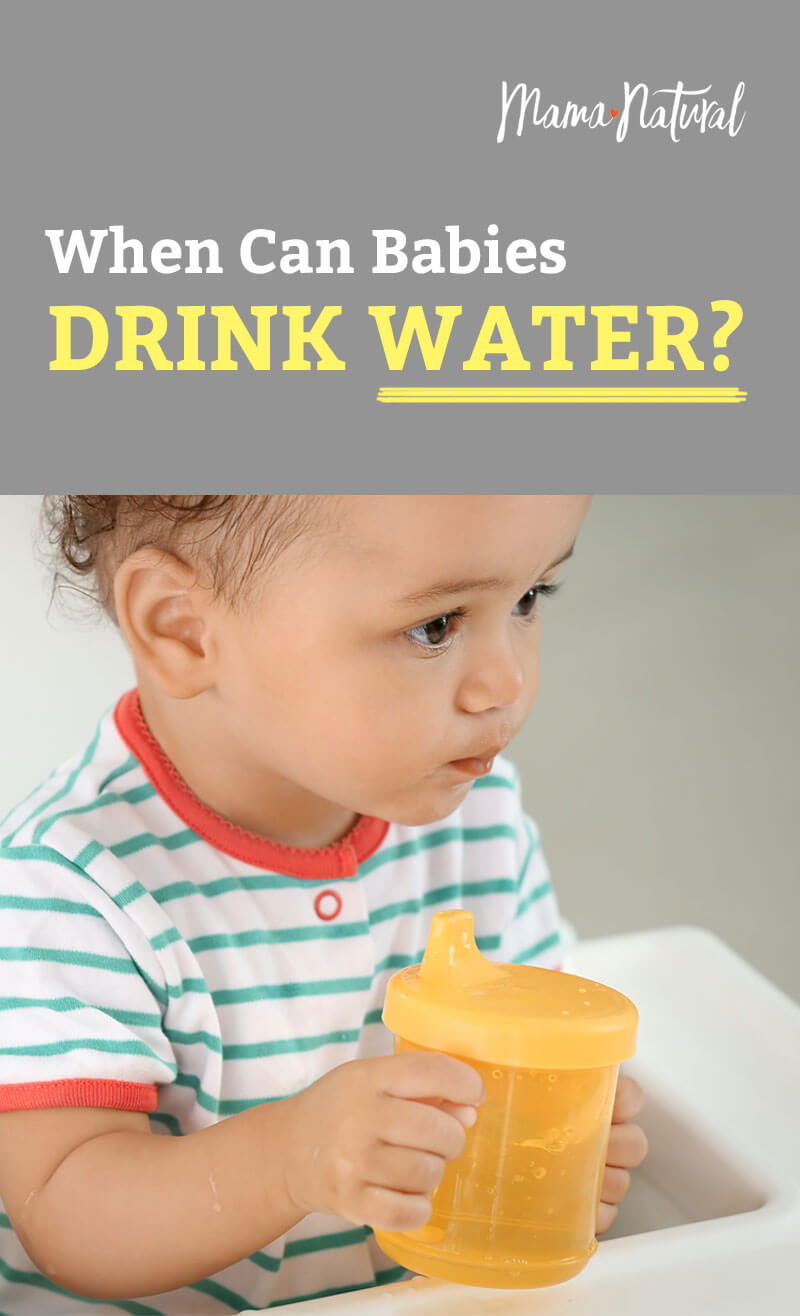
Once infant has the hand-eye coordination to hold a cup and is ready to showtime slowlydrinking water, here'south how to introduce a bottle of h2o or a sippy cup:
- Use a cup with handles that has either a soft spout or a harbinger. Try this one.
- Support your infant in an upright position and ever supervise. Baby may splutter and/or cough at outset.
- Mimic the action. Studies evidence that babies learn by imitation.
It's important to note that sippy cups should be considered a training tool to help a baby transition from a bottle or the breast to a loving cup—they are not intended for longterm use.
"Sippy cups were created to aid children transition from a bottle to drinking from a regular cup, but they're too often used for convenience," says American Academy of Pediatric Dentistry (AAPD) President Philip H. Hunke, D.D.S., M.S.D. "When kids sip for extended periods on sugared beverages, they're exposed to a higher risk of decay. Sippy cups should only incorporate h2o unless it'southward mealtime."
Once baby reaches his/her beginning birthday, they should be drinking from an open cup.
How to Introduce Water
Starting time off slowly!Like anything new, baby'due south system needs time to acquire how to process water. Effort a piddling bit—like a cap-full of water—at a time. Await and meet how your babe reacts. And never utilize h2o equally a meal replacement. If baby fills up on water, he/she won't get enough calories from breast milk, formula, and/or solid food. Plus, this can wreak havoc on your milk supply before y'all're ready to wean.
"From half dozen to 12 months, babies do not demand much h2o simply introducing some in a bottle or sippy cup can assist them go used to the sense of taste (or lack thereof) and consistency of the liquid." — Dr. Jennifer Shu, pediatrician, Children's Medical Grouping
"Limiting water to well-nigh 2 to 4 ounces per twenty-four hours is the typical recommendation as babies make the transition from an all-liquid nutrition to i involving solids," says Dr. Shu. Avid breastfeeding babies may need less or evidence no interest in drinking water. While "some babies may benefit from closer to half-dozen to 8 ounces per day (such as in the case of constipation or extremely hot and boiling weather)."
Later infant's showtime birthday, he/she can drink water more than freely, though the amount needed will vary based on whether or not (and how oft) mama is breastfeeding.
"After 12 months of age, a practiced rule of thumb is to offering milk with meals and h2o at near other times for thirst." — Dr. Shu
Talk to your pediatrician near how much water your child should be drinking each mean solar day.
Remember…
Like many things when it comes to raising children, there is no simple respond to the question when can babies drinkable h2o?How much water a baby tin drink—and when—depends largely on the child'southward chief food source and can even vary based on the climate where you live. The higher up information should be treated as rough guidelines— always talk to your pediatrician about what'south right for your child.
How About You?
When do you beginning giving your baby water? What tips do you have for getting older babies and toddlers to drink water?
Source: https://www.mamanatural.com/when-can-babies-drink-water/
0 Response to "When Should a Breastfed Baby Start Drinking Water"
Post a Comment